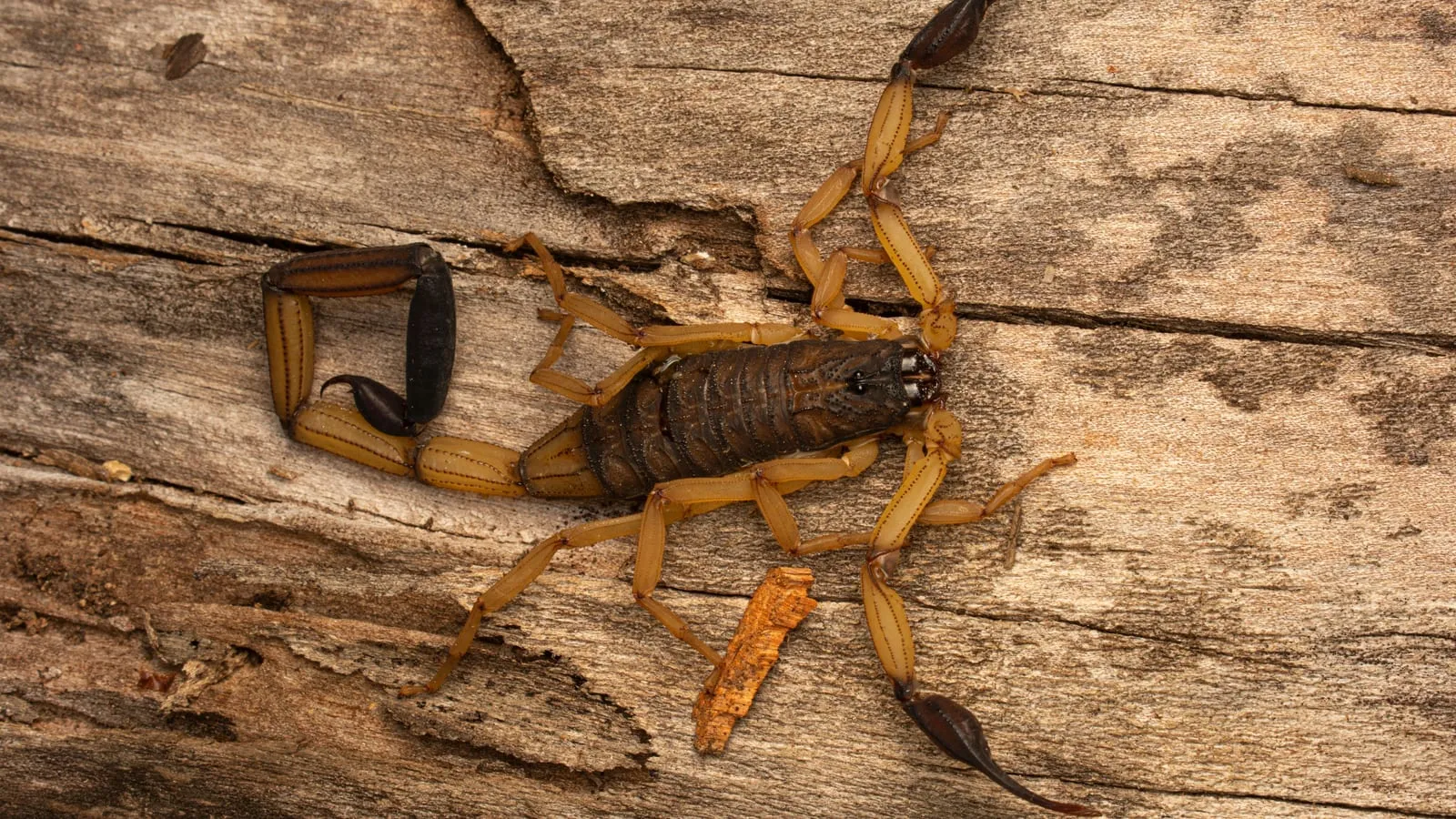
Scorpions are living fossils — a body plan that has worked, almost unchanged, for over 400 million years. They are hardy, quietly fascinating, and famously low-maintenance, and under a UV torch they glow an eerie blue-green that never stops being magic. But two things make species choice the whole game: venom and humidity. Pick right and a scorpion is one of the easiest invertebrates you can keep.
Choose the species before anything else
Not all scorpions are beginner animals, and the gap between “docile and forgiving” and “medically significant” is enormous. Start with one of these.
- Emperor scorpion (Pandinus imperator) — the classic first scorpion. Large, glossy black, slow, and famously docile, with mild venom often likened to a bee sting. Needs a humid, tropical setup.
- Asian forest scorpion (Heterometrus spp.) — similar humid care to the emperor, but noticeably more defensive and quick to raise its claws. A reasonable second species.
- Desert hairy scorpion (Hadrurus arizonensis) — North America’s largest scorpion and a great intro to arid keeping, with a dry setup instead of a humid one.
There is a rough field rule worth memorising: scorpions with large, robust pincers and a thin tail tend to have milder venom, while those with thin, spindly pincers and a thick, muscular tail — many buthids, such as deathstalkers — can be genuinely dangerous. A heavy-pincered animal subdues prey by crushing; a thin-pincered one relies on its sting.
Beginners must stick to the docile species above and avoid hot, buthid, and “deathstalker” species entirely — their venom can be life-threatening, and no amount of experience makes that risk worth taking at the hobbyist level.
Housing: secure first, everything else second
Scorpions are escape artists. They are flat, strong, and patient, and they will exploit a gap you would swear was too small. Your enclosure must seal completely.
- A secure, tight-fitting lid with no gaps around cords or vents. A scorpion loose in the house is a problem for everyone, including the scorpion.
- Good cross-ventilation to stop stagnant, mouldy air — especially important for humid setups.
- Deep substrate for burrowing: a coir-and-soil mix for humid species, a sand-and-soil blend that holds a burrow shape for arid ones. Give them several inches; they dig.
- A hide — a slab of cork bark or a half-log — so the animal can stay out of the light and feel secure.
- A shallow water dish. Too deep and a scorpion can drown; a dish with pebbles or a sponge gives it a safe place to drink.
A single scorpion per enclosure is the safe default. Communal setups exist for a few species but are an advanced, risky game — stressed scorpions cannibalise.
Temperature and humidity
Most popular species do well at a steady 75–85°F (24–29°C). A low-wattage heat mat on the side of the enclosure (never directly under a burrowing animal) is usually enough; aim for ambient warmth, not a basking hot spot.
Humidity is where species choice pays off:
- Humid species (emperor, Heterometrus) want roughly 70–80% humidity. Keep one side of the substrate damp and let the other dry out, creating a moisture gradient by lightly misting one end every few days.
- Arid species (desert hairy) are kept dry, with a single humid hide — a corner of damp substrate or a moist hide box — so they can rehydrate when they need to without sitting in damp.
Avoid soaking the whole enclosure. Constant wetness with poor airflow breeds mould and mites far faster than dryness ever hurts these animals.
Feeding
Scorpions are ambush carnivores. Feed appropriately sized live insects — crickets or roaches roughly the size of the scorpion’s body or smaller — once or twice a week.
- Use feeding tongs to offer prey. This keeps your fingers out of strike range and lets you place food near the burrow.
- Dust prey with calcium to round out the diet.
- Remove any uneaten prey, especially a loose cricket, which can stress or even injure a scorpion — most importantly in the days before and after a moult.
A scorpion that ignores food for a while isn’t necessarily sick. Many fast naturally, and a moult is almost always coming.
Moulting: the most vulnerable window
Scorpions grow by moulting — splitting and shedding their old exoskeleton. For several days afterward the new shell is soft, pale, and defenceless, and the animal cannot protect itself or feed properly.
- Do not feed during or just after a moult, and pull any live prey out of the enclosure.
- Do not disturb or handle a freshly moulted scorpion.
- Ensure adequate humidity beforehand — a too-dry environment is the leading cause of a stuck, incomplete moult, which can be fatal.
Give it space and time. Within a week or so the new exoskeleton hardens and darkens, and normal feeding can resume.
Handling and safety
The honest answer is: don’t handle your scorpion. Even mild species sting, and the real danger isn’t the venom potency of an emperor — it’s an allergic reaction, which can turn a bee-sting-grade sting into a medical emergency. There is no upside that justifies the risk.
When you need to move one, coax it into a deli cup or guide it with long tongs. Never use bare hands. As with keeping a tarantula, the goal is a fascinating animal to observe, not to pet.
Watch body condition instead. A healthy scorpion has a plump, well-rounded body and mesosoma; a shrivelled, sunken abdomen signals dehydration or a feeding problem and is your cue to check humidity, water, and prey.
Scorpions reward patient observation more than interaction — the change in a moult cycle, a drift in body condition, the rhythm of feeding refusals. Logging feedings, moults, and weights in LizardBox turns those slow, easy-to-miss signals into a clear picture, so you catch a stalled moult or a thinning body before it becomes a problem.