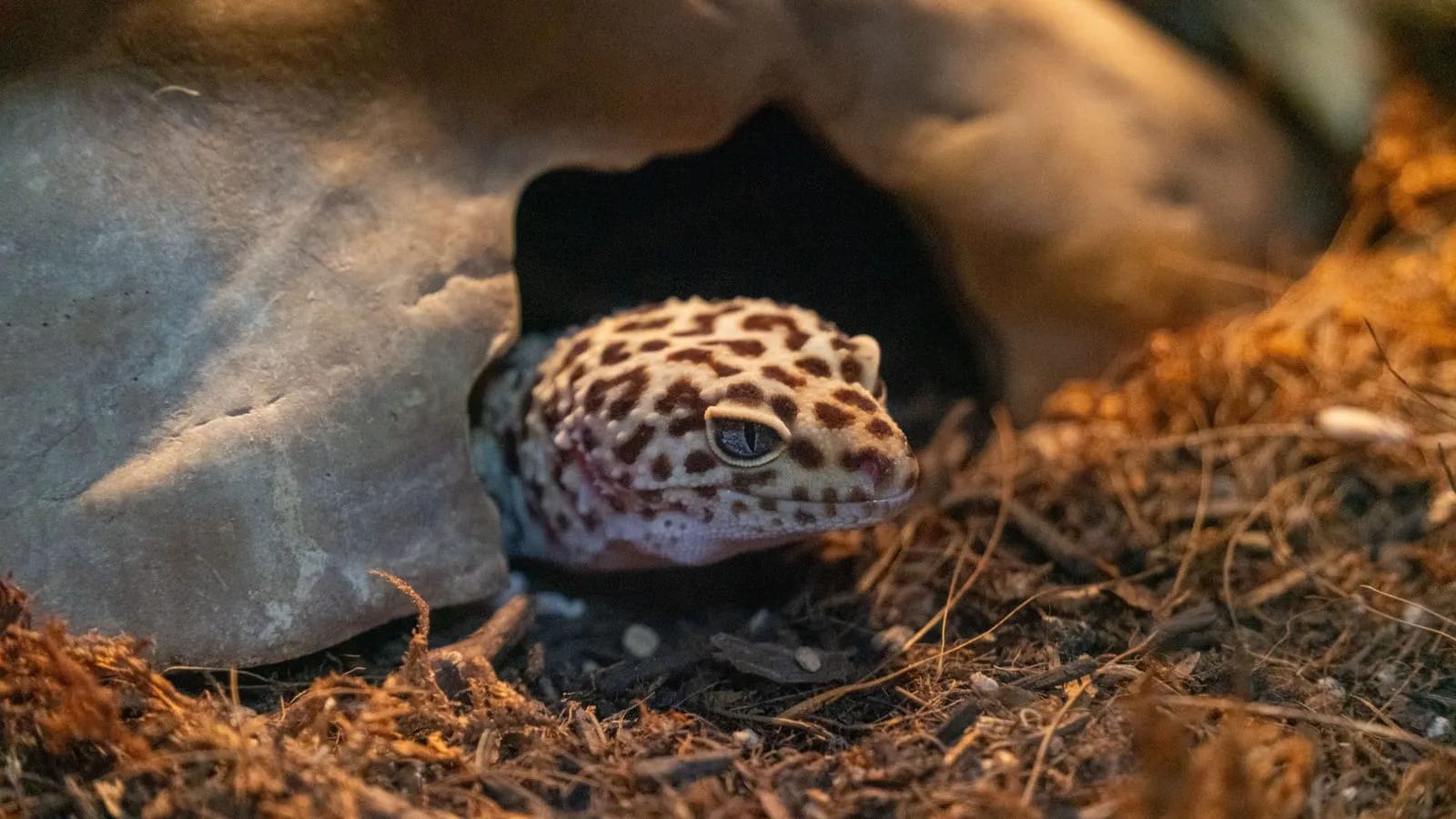
Leopard geckos earn their reputation as the best first lizard: hardy, docile, and most active in the evening when their keepers are actually home. They don’t need a towering bioactive jungle or a wall of lighting — but “easy” still means a real setup and a real routine. Get the fundamentals right and a leopard gecko will thrive for fifteen to twenty years.
The enclosure
A single adult leopard gecko needs a 36 × 18 in footprint — a 40-gallon breeder or a 36 × 18 × 18 in terrarium — and, as always, more floor space is better. The 20-gallon long you will still see quoted in shops is only 30 × 12 in; a gecko survives in one, but it does not get to do much. Leopard geckos are ground-dwellers, so length matters far more than height.
- Floor space over height. They explore horizontally; a tall tank wastes the space they actually use.
- Front-opening doors let you interact at eye level instead of looming from above, which reads as a predator.
- One gecko per enclosure. Two females can sometimes cohabit, but it often ends in bullying — for a first keeper, solo is the safe default. Never house two males together.
Hides: three is the rule
Hides are not decoration — they’re how a leopard gecko feels safe enough to behave normally. Provide three:
- A warm hide on the heated end.
- A cool hide at the opposite end.
- A humid (moist) hide — a covered box with damp sphagnum moss — which is essential for clean shedding.
Heating and temperature
Leopard geckos thermoregulate by moving across a gradient, and they take in heat through their bellies, so a warm surface matters.
Aim for a warm-side surface temperature of 90–92°F (32–33°C) and a cool end around 75°F (24°C). Always run any heat source through a thermostat — an unregulated mat or bulb is the single most common cause of burns and overheating.
An under-tank heat mat on the warm end is traditional; a low-wattage overhead halogen adds helpful ambient warmth in cooler rooms. A natural night-time drop into the low 70s°F is healthy.
UVB: recommended, not optional
For years UVB was considered unnecessary for this crepuscular species. Modern best practice has moved on: a low-output UVB tube (T5, 5–7%) — a Zoo Med Reptisun 5.0 or an Arcadia ShadeDweller — supports calcium metabolism and long-term health. If you don’t provide UVB, you must supply dietary vitamin D3 to let the gecko use calcium — without one or the other, metabolic bone disease is the result.
Substrate
For beginners, use a solid, non-loose substrate — tile, slate, or a sealed surface — which eliminates impaction risk and wipes clean. Avoid loose sand with juveniles entirely. Experienced keepers can run a proper bioactive desert-soil mix, but that’s an upgrade, not a starting point.
Feeding
Leopard geckos are strict insectivores. Build the diet on staple feeders and treat the rest as occasional:
- Staples: crickets, dubia roaches, and mealworms — ideally gut-loaded for 24 hours first.
- Treats only: waxworms and superworms are fatty; offer them sparingly.
- Supplements: dust feeders with plain calcium at most feedings, and add a multivitamin with D3 once or twice a week (especially if you’re not running UVB).
Hatchlings eat daily; adults eat every other day or a few times a week. Always keep a shallow dish of fresh water available.
Shedding and hydration
Leopard geckos are desert animals and stay mostly dry, but the humid hide does the real work at shed time. Watch for retained shed on the toes and over the eyes — stuck shed on a toe can cut off circulation and cost the gecko a digit. If a shed looks incomplete, raise humidity in the moist hide rather than ever peeling skin off by hand.
Handling and the tail
Leopard geckos tolerate gentle handling well once settled. Let a new gecko acclimate for a week or two, then keep early sessions short and low to the ground.
- Support the whole body and never restrain or grab the tail — a stressed gecko can drop it as a defense. It regrows, but the replacement is a stubby “carrot” that never looks the same.
- A plump tail is a fat reserve and a key health gauge: a thinning tail is an early sign something’s wrong.
Building the routine
The hardest part of keeping any reptile isn’t the setup — it’s the consistency afterward. A leopard gecko that skips two feedings, drops weight, or sheds poorly is telling you something, and those signals are easy to miss day to day.
That’s exactly what LizardBox is built for. Log feedings, weights, and sheds, set a reminder for the annual UVB swap, and let each weigh-in build into a curve you can read at a glance — so you catch a small change while it’s still small, and your first gecko becomes a thriving one rather than just a surviving one.